

Table of Contents
Visa Tanzania
Do I need a visa?
After you have booked your Tanzania safari or Zanzibar holiday, the next thing to do is to apply for your tourist visa. How to apply? Where to apply? What documents do you need? We have the answers to all your questions. And you will see, getting a visa for Tanzania is relatively easy.
Good to know: when travelling to Tanzania, you can either get your visa online or upon arrival.
How much does a Tanzania visa cost?
The costs for a Tanzania visa differ slightly per nationality. Are you from Europe? Then the fee is 50 USD. Are you a US citizen? Then you need a multi-entry visa for the price of 100 USD. Both are valid for three months, but the multi-entry visa allows you to leave the country and come back again with the same visa within one year.
The amounts above apply when you purchase your visa online. If you apply for a visa upon arrival, it either costs 50 USD or 50 EUR (or 100 USD for the multi-entry visa), even though 50 EUR obviously does not equal 50 USD. You can either pay for your visa in cash or with a credit card – then the fee is 50 or 100 USD plus credit card fees. The choice is yours.
Why apply online?
The Tanzanian government prefers you applying online, and truth be told, it does have its perks:
The process is relatively easy, especially with the explanatory PDF you get when booking through us.
You board your plane knowing your visa is arranged and paid for.
Upon arrival, you only have to wait at one counter to get your visa stamped.
To apply for a visa online, you go to the official portal of the Tanzanian government. We advise you to NOT apply through any other website because they are either more expensive or scams. We know of several travellers who lost their money through these scams, so it’s better to be safe than sorry. The official portal is: https://visa.immigration.go.tz/.
When guests book with us, a guide will help them through the process. And our travel consultants are always available for advice, too. Even though we cannot apply for your visa, we can make everything works out. If you submit your visa application online, it can take up to two weeks before your visa is processed and approved. Make sure to have a printed or downloaded version of your visa when you embark on your journey. If you apply for a visa online, you only have to queue at the immigration counter to get your visa stamped in your passport. Then you collect your bags and you’re good to go. Easy!
Is it possible to apply for a visa upon arrival?
If, for some reason, you cannot or don’t want to apply online, you can also still apply for a visa upon arrival. Apart from some nice African bureaucracy, the process is quite easy:
You fill out an application form upon arrival at the airport (keep a pen at hand and have the address of Tanzania Specialist and your first lodge at the ready).
Apply at the visa counter.
Go to a second counter to pay your visa fee, and pay either in cash or by credit card.
Go to a third counter, and get the visa stamped in your passport.
Get your bags, and you’re good to go.
As you can see, if you apply for your visa on arrival, you’ll have to queue three times, while applying online means queuing just once when you arrive. So applying the old-fashioned way might slow you down a bit. But since you are in the country of “pole pole” now – which is Swahili for “long rush” – you might as well get used to it. And just between you and us: these days so many people apply online that the one queue for online applications is way longer than the three queues for a visa on arrival. So you might even be out quicker.
What is the best choice?
Nowadays, most people prefer to apply online. This way they can be sure to have the visa in their pocket before travelling. Which is understandable. If you decide to apply online, make sure to be prepared:
Apply three to four weeks before your trip, in case your application gets denied. This will give you enough time to correct the mistakes and apply again.
Have a credit card ready for your payment, or know how to make an international bank transfer.
Have a digital passport-size picture, a picture of your passport’s biodata page (max. 300KB) and a PDF of your flight ticket (max. 1MB) ready.
Make sure your passport is valid for six months upon return from Tanzania.
If children travel with only one parent, you need a written document in English with the consent of the other parent for the trip, and then you have to upload this into the system.
Make sure to have a pen at hand when arriving in Tanzania, because sometimes there is still a form they ask you to fill.
If you decide to be a bit adventurous and apply upon arrival*, don’t board the plane unprepared, either.
Carry the amount needed for the fee in cash (USD/EUR), or use your credit card.
No passport-size picture is needed.
Have a pen at hand to fill in the application form, and the addresses of Tanzania Specialist and the first hotel you stay in.
If children travel with only one parent, you need a written document in English with the consent of the other parent for the trip.
*Nationals of some countries need a so-called Referral Visa and are not allowed to apply upon arrival. So make sure to check that before you decide on how to apply. Also, applying for a visa upon arrival might not be possible any more in the future for anyone, so make sure to check the immigration guidelines before you leave to make sure that it’s still possible.
Travel insurance
Do I need a travel insurance?
Embarking on an African safari to Tanzania is an adventure of a lifetime. But don’t forget to pack one of the most important things: travel insurance!
A good travel insurance plan provides peace of mind by covering medical emergencies, trip cancellations, and other unforeseen events. It’s essential to have a reliable safety net, especially in remote areas where access to medical facilities and other services can be limited. Comprehensive travel insurance lets you focus on the thrill of the safari, knowing that you’re protected against the unexpected.
Which travel insurance do you recommend?
We recommend Chapka Travel Insurance for your Tanzania journey. Chapka offers tailored coverage that meets the unique needs of your trip, ensuring you only pay for what you need. From 24/7 medical teleconsultation to handling lost baggage claims – Chapka’s services are designed to keep your safari experience in Tanzania smooth and worry-free.
Their personalized plans mean you’re fully covered both before and during your trip, allowing you to immerse yourself in the beauty and excitement of Tanzania without any added stress. This way you know that in the most unfortunate situations (cancellation, immediate return, hospitalization, legal fees, trip interruptions, rescue operations, and medical expenses) you are covered.
With Chapka Travel Insurance, you can embrace the adventure with confidence, knowing that help is just a call away whenever you need it.
Get a quote today and get ready for a worry-free Tanzania adventure!
Is travel insurance mandatory when visiting Tanzania?
Yes, it is! Better put, as of September 28th 2026, you are obligated to obtain the Tanzania Mandatory Travel Insurance, issued by the Tanzanian government.
All foreigners visiting the country need to get this insurance, regardless of your own travel insurance. With this, the Tanzania government aims to protect travellers who come to Tanzania and reduce the financial risk for the Tanzanian government.
The basic coverage of this mandatory travel insurance includes the cost of emergency medical expenses, repatriation expenses, baggage loss, and emergency evacuation. The costs of the insurance are 44 USD per person, and it’s valid for 92 days (multi-entry). Children of 17 years or younger pay 22 USD, while infants up to 2 years don’t need to pay. To apply for Tanzania’s mandatory travel insurance online, please visit the website of the National Insurance Corporation. After payment, you receive a QR code to be shown upon arrival. Alternatively, you can obtain this insurance upon arrival in the country at all land border crossings and at the international airports, including Kilimanjaro International Airport (JRO) and Julius Nyerere International Airport (DAR).
Please note that if you first visit Zanzibar, you need to obtain the Zanzibar Mandatory Travel Insurance from Zanzibar Insurance Corporation (ZIC). If you visit both Zanzibar and mainland Tanzania, you obtain your insurance from the place where you first set foot in the country.
Is travel insurance required when visiting Zanzibar?
Yes, it is! Better put, if Zanzibar is your first port of entry when visiting Tanzania, you are obligated to obtain the Zanzibar Mandatory Travel Insurance, regardless of your own travel insurance.
Each traveller needs to apply for this insurance in advance via the portal of the Zanzibar Insurance Corporation (ZIC). After a payment of 44 USD per person, you receive a QR code to be shown upon arrival. The basic coverage of this mandatory travel insurance includes the cost of emergency medical expenses, repatriation expenses (body and medical), personal accidents, baggage delays, baggage theft, baggage loss, legal expenses, and personal liabilities.
Please note that if your first port of entry is on the mainland of Tanzania, you need to obtain your mandatory travel insurance from the National Insurance Corporation. For both, the costs are the same, but this one can also be obtained upon arrival in the country.
Do I need cancellation insurance for my trip to Tanzania?
It is advisable to sign up for a cancellation insurance. In some cases, only a portion of the cost is refunded if a long trip is cancelled. Please check this with your insurer to make sure you are properly insured.
Vaccinations
Do I need vaccinations?
In addition to standard vaccinations such as MMR and TDP, the CDC and WHO recommend vaccinations for Tanzania, such as Hepatitis A, Hepatitis B, and typhoid. Yellow fever and rabies vaccinations are also recommended depending on the traveller’s activities.
Tanzania yellow fever requirements can sometimes seem confusing, but we’re here to help! As a yellow fever-free country, Tanzania is safe to travel when it comes to steering clear of this virus. You may have questions about it, so we’ve answered them here.
What to bring
What to pack for a Tanzania safari? Your ultimate safari packing list.
Whether you are experienced when it comes to safari tours or it is your first time: it is important to know exactly what you need to bring with you. And we are here to help you out!
In the Tanzania safari packing list below, we will go through all the items you need to take with you and explain why you should bring them. Let’s get started.
Travel Documents
Passport: This is a no-brainer, but it can sometimes be tough to remember to pick up your passport on your way out of the door. Make a note about remembering your passport somewhere that you can be sure that you will see it, such as on the fridge or on the bathroom mirror. Also, make sure that your passport has a minimum validity of six months.
Plane Ticket: Another obvious necessity, but again, it can be easy to forget them when you’re in a hurry.
Visa: E-visas are recommended as they can be arranged in advance, and they can be useful when it comes to avoiding any potential issues with obtaining a physical visa once you get to Tanzania. However, if it is necessary, they are available upon arrival in the country.
Travel Insurance: An insurance will keep you covered for issues that might pop up during your trip to Tanzania, such as cancellations, flight delays, evacuations, theft, or loss of property, and any necessary medical expenses.
Money
It’s best to be as prepared as possible when it comes to the money that you bring with you, so a mixture of debit or credit cards as well as cash is going to be your best bet. Even though dollars and euros are still used in the most touristic places, the only official currency is the Tanzanian shilling and should be used, especially for all your small expenses.
Versatile Clothing
Clothing can be a tricky element of a safari to pin down, as you never know exactly what you are going to get when it comes to the Tanzania weather.
Tanzania experiences both wet and dry seasons, with the dry seasons falling between January and February and then between June and October and the wet seasons lasting from March to May and then from November to early December.
For a safari in the dry season, you aren’t likely to see any rain, but it’s best to pack a few jackets just to be sure. Otherwise, light clothing will suffice. The wet seasons call for heavier clothes, such as scarves and thicker jackets.
There are also general clothes that you will want to make sure that you pack no matter what season you travel in, such as the following:
Long-sleeved shirts
Trousers
Shorts
Waterproof jacket
T-shirts
Socks
Warm sweaters
Swimsuits
Hats
As a whole, lightweight outfits in neutral colours are a practical choice for a safari, but remember that layering is your best friend!
Sturdy and Comfortable Footwear
You might be doing a fair amount of walking during your safari (especially if you join a walking safari) and therefore comfortable footwear is a must.
A pair of sneakers that you can get dirty is a great idea, whilst sturdy hiking boots with trustworthy ankle support are also a necessity.
If you plan to relax at the beach as well, don’t forget your flip-flops or sandals!
Medical Kit
A basic first aid kit will help you in case of any unexpected mishaps or illnesses during your safari.
From regular painkillers to medications to avoid sickness and diarrhoea – you want to make sure that you are stocked up on the essentials. This way, you can continue to enjoy your trip even if you have to deal with any medical problems.
Some of these essentials include:
Anti-bacterial medicines
Anti-malaria medications
Anti-diarrhoea medications
Plasters
Gauze and bandages
Adhesive tape
Hand sanitizer
Eye drops
Nose spray
Even the smallest first aid kit will do, as long as you have the right tools for any cuts, bruises, or reactions that might occur!
Toiletries & Sun Protection
Toiletries
When it comes to toiletries, simply bring the same kind of items you would bring to any other holiday, such as the following:
Toothpaste
Toothbrush
Soap
Shampoo
Conditioner
Mouthwash
Deodorant
Travel towels
Hairbrush
Lotions
Feminine hygiene products (if necessary)
A safari is also a happy place for insects, so make sure you also bring some strong insect repellent in order to avoid being swarmed or bitten!
Sun Protection
You also need to keep in mind that you are going to be outside for a long period of time whilst on safari, so protection from the sun is crucial. Besides sunscreen, bring some after-sun lotion as well.
Electronics and Gadgets
Of course, you want to capture the moments you experience during your safari for eternity. Next to a phone, a camera should be on your list of essential items.
Don’t forget the charger for your camera (that goes for your phone too!) and spare batteries, as well as an extra memory card. Universal plug converters and binoculars are a must too!
Don’t forget to keep your electronics protected at all times, especially if you explore Tanzania during the rainy season. Some extra protective coverings or waterproof bags to keep them in might prove useful.
Baggage
Make sure you store all your belongings safely in matching kinds of storage. This could include the following:
Backpack
Waterproof duffel bag
Daypack
Ziplock bags
This will make it easier to decipher your everyday items from your specific safari items.
What to wear
What to wear on a Tanzania safari
Long trousers or shorts? T-shirts or tops? Flip-flops or sneakers? Or maybe even hiking boots? Your trip is booked (or you are about to book it), and you’re standing in front of your closet, not knowing what to bring. Don’t worry, we’ve all been there.
Let’s start with some good news: most of what you need you probably already have at home. But of course you won’t pack your bag the same way whether you’re climbing Mount Kilimanjaro or making your way to the world-famous Zanzibar Island.
What will the weather be like?
Tanzania weather differs from region to region – but there is always a great time to travel in Tanzania! Weather in the coastal areas is the hottest and most humid, while the North and highlands of Tanzania are cooler because of altitude. The temperatures vary between 22 °C and 31 °C throughout the year. During the night, the temperature in Tanzania drops to between 10 °C and 22 °C. The beaches of Zanzibar have a distinctively tropical climate, since it is located close to the Equator. On this page, you can read more about the weather in Tanzania.
What are recommended safari clothes?
It is advised to wear loose, comfortable, and easy-to-wash clothing. The idea is to bring only what you need because most camps and lodges will wash your clothes for little money. There is no need to dress up for safaris because they are casual – and even with your practical safari clothes, you’ll cut an Instagram-worthy figure!
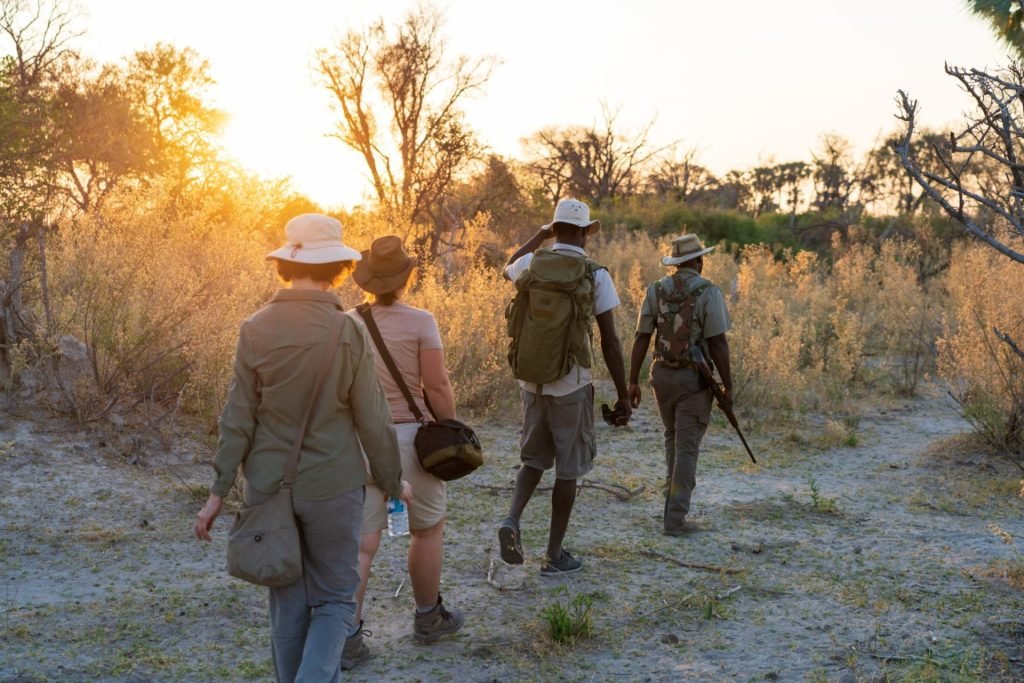
Plan to wear layers so you can acclimatize to weather variations. Indeed, depending on the time of year, early morning game drives can be rather chilly while daytime temperatures can get quite warm. Instead of dark blue or black, which tends to draw tsetse flies, wear neutral or khaki-coloured clothing so that you blend right in. Sunglasses, insect repellent, sunscreen, and wide-brimmed hats are essential. It’s recommended that you wear long pants, long-sleeved shirts, socks, and insect repellent to prevent mosquito bites after dusk.
Here is a checklist of every piece of clothing you should take and what to wear on your Tanzania safari. So you can refer to it while you pack for your trip.
T-shirts and tank tops
Long-sleeved shirts
Shorts
Light long pants or convertible long-short pants
Warm fleece pullover or jacket
Bandana
Heavy sweater if travelling in the cold season
One swimsuit – for at the pool in your accommodation or at the beach
Cotton socks and underwear
Pajamas
One pair of comfortable walking shoes
One pair of sandals or flip-flops
Wide-brimmed hat
Sunglasses
Which extra items should I pack?
Pack light when you travel to Tanzania, and only bring the most necessary. And should you forget something at home, you can probably get it there as well. Here are some extra essentials you can check off your list when packing for your vacation.
Documents, money, and other necessities
Credit cards and ATM bank cards
Yellow fever vaccination certificate, if necessary
US dollars in large and small bills
Passport
Plane tickets
Travel insurance policy
Emergency contact numbers
Safari itinerary
Small torch or headlamp
Camera, extra memory cards, batteries, and charger, if applicable
Ziplock bags for toiletries, camera equipment, snacks, and so on
Everything for your wellbeing
Sunscreen and lip balm
Insect repellent
Eye drops and extra contact lenses or spare glasses if necessary
Anti-bacterial hand sanitizer
Tissue paper and a small travel towel
Personal toiletries
First aid kit
Tylenol
Anti-malaria pills
Cold and allergy medicine
Itch medication
Plasters
Stomach ache remedy
Antibiotic cream
Anti-diarrhoea medicine
Prescription antibiotic for travellers’ diarrhoea
Prescription medications
What clothing to wear in Zanzibar?
If you decide to explore Stone Town or any other part of Zanzibar other than the beach resorts, it’s best to dress modestly. Women shouldn’t dress in short skirts, thigh-high shorts, sleeveless shirts, or exposing shirts. However, Capri trousers or at least knee-length shorts, and of course long dresses and skirts are fine. For men, knee-length shorts or pants are appropriate.
Can-brings for your beach holiday in Zanzibar
You already have your swimsuit in your suitcase, as well as sun protection, sunglasses and a fancy hat! Depending on how you want to spend your time on this almost-too-beautiful-to-be-true island, we have a few more tips on what to bring.
Journal – Write down what you’ve done, what you’ve seen and which animals you’ve met on your safari.
GoPro – If you want to go snorkelling or diving, this would be ideal to capture all the tropical fish you’ll encounter… figuratively, of course.
Book(s) – Imagine relaxing on the white beach with the sound of the waves and a good book in your hand… if you want to learn more about Tanzania, we can recommend these.
Headphones – Should you want to listen to your favourite music or podcast while chilling at the beach.
What to bring to climb Kilimanjaro?
Should you want to add a Kilimanjaro trek on your list, have a look at here to find everything you need to know about the preparation and, of course, on what to pack!
Flights
Planning your journey to Tanzania starts with choosing the right flights. While we take care of all domestic flights within Tanzania as part of your safari package, you are free to select the international flights that best suit your schedule and preferences.
Can I book international flights with you?
Yes, we can assist with booking international flights. However, these are not included in the price of our travel packages and are arranged on demand based on your preferred dates, departure airport, and airline. All internal flights within Tanzania are included in the package price and will be arranged for you as part of your itinerary.
If you need some help in finding suitable international flights, our team is happy to help.
What is the baggage allowance for domestic flights in Tanzania?
Domestic flights (for example, from Arusha to Zanzibar) have a baggage allowance of 20 kilograms. Some airlines only allow soft case bags, others allow 5 kilograms of hand luggage. Safari flight routes may have different baggage requirements. The maximum dimensions (L+W+H) for a check-in luggage are 125 centimetres or 49 inches. The maximum dimensions (L+W+H) for hand luggage are 85 centimetres or 33 inches.
If your luggage exceeds this limit, airline companies usually charge from 5 to 7 USD per additional kilogram, which you can pay directly at the check-in desk. Please note that if you travel with hard-case suitcases, a domestic airline may deny boarding.
Tanzania Specialist cannot be held liable in case your hard-case suitcases get damaged during the safari or if the airline blocks or charges you when the above luggage regulations are not followed. If you have questions, please ask your travel consultant or check the airlines’s website.
General info on Tanzania
You’re probably curious about the country you’ll soon be exploring. To help you get acquainted, we’ve gathered a few useful facts about Tanzania. From its currency and official languages to time zone and population – here’s everything you need to know before your adventure begins.
What is the currency of Tanzania?
The local currency is the Tanzanian shilling. And even though dollars and euros are still used in the most touristic places, the only official currency is the Tanzanian shilling and should be used, especially for all your small expenses.
What language is spoken in Tanzania?
There are over 100 different languages spoken in Tanzania. The official languages, however, are Swahili and English. You can expect all your Tanzania Specialist guides and hosts to speak English, but if you’re looking to learn a few words of Swahili before your trip, check out our list of top 25 useful words in Swahili!
Swahili is spoken by almost everyone. In the tourism sector, however, English is widely spoken by the majority of people.
What is the population of Tanzania?
The population of Tanzania is almost 60 million. One of Africa’s most ethnically diverse countries, around 125 different ethnic groups live in Tanzania, with more than 100 different languages spoken nationwide.
The Tanzanian people are well-known for their hospitality, often warmly welcoming tourists to experience their beautiful nature, wildlife and culture. If you really want to learn more about the country and its culture, be open and talk to the locals.
What is the time in Tanzania?
Tanzania is GMT +3. To put that into terms we all understand, check out the time difference from Tanzania to LA, New York, London and more below.
Los Angeles: -10 hours
New York: -7 hours
London: -3 hours
Berlin: -2 hours
Hong Kong: +5 hours
Tokyo: +6 hours
Sydney: +8 hours
Auckland: +10 hours